
C. S. Lewis believed you could tell a literary reader from an unliterary one by a single habit. The first time through a book, the eye is busy with the mechanics of the thing, moving left to right, line after line, learning who is who and where we are. Only on a second or third reading can a book be held in the mind the way a painting is held in the eye, all at once.
The sure mark of an unliterary man is that he considers ‘I’ve read it already’ to be a conclusive argument against reading a work.
C. S. Lewis, An Experiment in Criticism, 1961
It is a severe test, and Lewis meant it to be. But it names something most serious readers recognise. The books that matter most to us are rarely the ones we read once.
The case against the pile
Contemporary reading culture is built around accumulation. Reading challenges, annual totals, lists of the hundred books to read before you die. Publishers need new titles, newspapers need new reviews, and social media rewards the person who has just finished something. In that economy, rereading looks almost like waste, a refusal to move on.
Yet literary history points the other way. Montaigne spent two decades rereading and annotating the same library in his tower. Virginia Woolf returned again and again to the Greeks, and wrote about the difficulty of it in “On Not Knowing Greek”. Proust’s narrator spends much of In Search of Lost Time reconsidering things he thought he had already understood.

What changes the second time
The text, obviously, does not change. What changes is the reader, and therefore the encounter. Italo Calvino, in his essay “Why Read the Classics?”, described a classic as a book that has never finished saying what it has to say. He also observed that the books we read young are often read badly, too quickly and without the experience to understand them, and that returning to them later can feel like reading them for the first time.
Anyone who has returned to Middlemarch at forty after first meeting it at nineteen knows this. Dorothea’s mistakes look different once you have made some of your own. Casaubon, who seemed a simple villain, becomes a portrait of a frightened scholar who cannot finish his life’s work, and that is a far more uncomfortable thing to read.
Poetry makes the point even more sharply. Hardly anyone reads a good poem once and feels finished with it. We learn poems the way we learn a piece of music, by going back, until certain lines begin to arrive before we reach them on the page. Novels deserve the same patience, even if their length makes it harder to give.
The pleasure of knowing the ending
There is a particular pleasure available only to the rereader, and it is closer to music than to storytelling. Freed from suspense, we notice structure: the way an early image returns, transformed, near the end; the rhythm of a chapter; the small decisions of syntax that a first reading races past. We start to see how the thing was made.
This is also where rereading becomes a kind of criticism. You cannot really argue with a book you have read once. You can only report your impressions. A second reading lets you test those impressions against the text, and often you find that the book was cleverer, or stranger, than you remembered.
A small experiment
A few practical suggestions, for anyone who wants to try:
- Choose a book you loved before you were twenty-five and have not opened since.
- Read it with a pencil, marking only what surprises you.
- Notice which passages you remember, and which seem entirely new.
The last of these is usually the most revealing. Memory edits books ruthlessly. We keep a scene, a phrase, a feeling, and lose the rest. Rereading restores what was lost, and shows us, sometimes painfully, what we chose to keep and why.
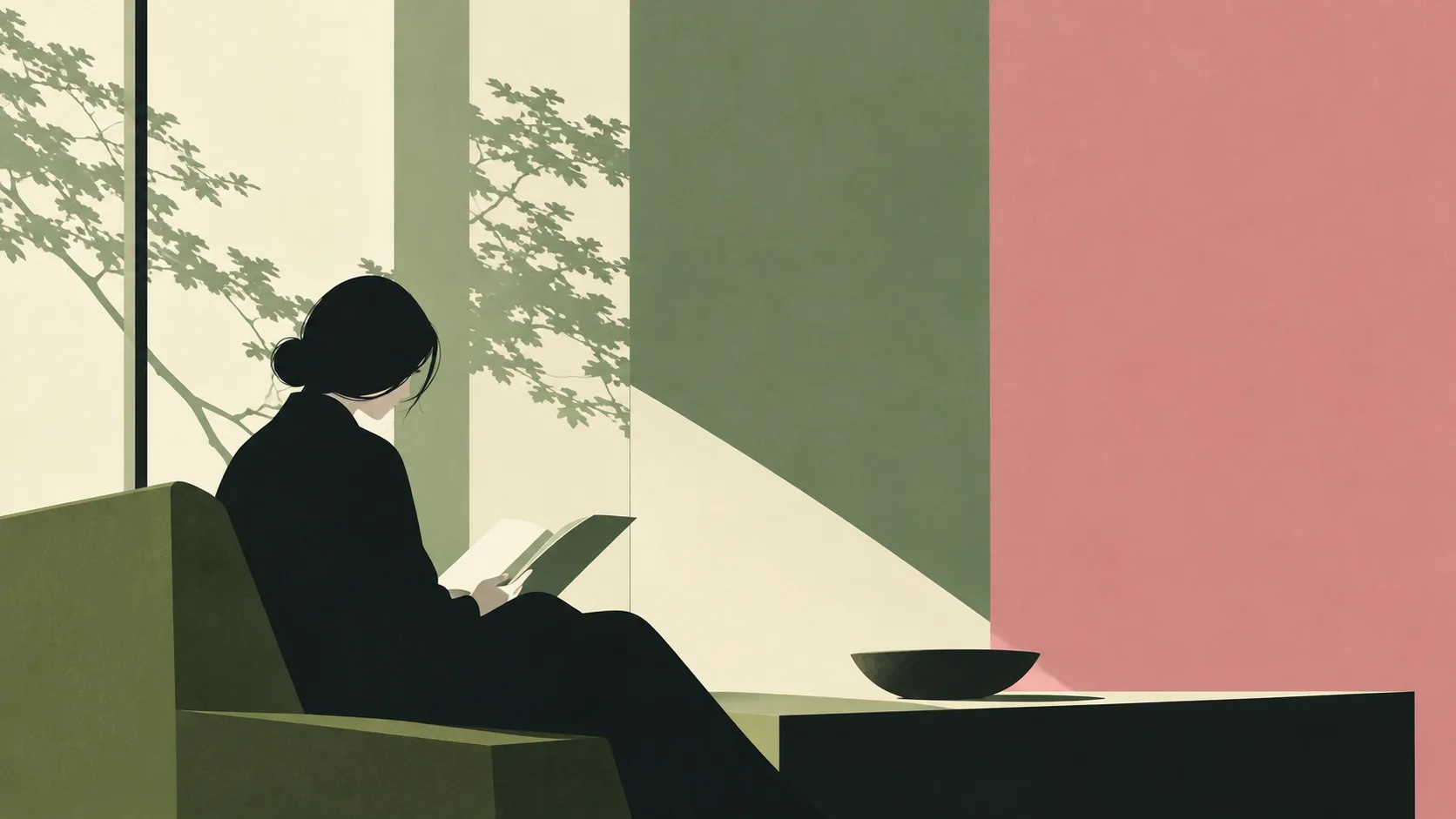
The woman in the green armchair in our image is reading slowly, in the afternoon light, with nothing on the table but an empty bowl. It is not a picture of productivity. It is a picture of attention, which is what rereading asks for and what it gives back.



View comments (0)