

When Annelise Fleischmann arrived at the Bauhaus in Weimar in 1922, she did not particularly want to weave. Like many women at the school, she was steered away from the more prestigious workshops and toward textiles, which the institution regarded as a suitably feminine field. She went reluctantly. Within a few years, as Anni Albers, she had become one of the most original artists the Bauhaus produced.
The weaving workshop
The Bauhaus weaving workshop, led in the later 1920s by Gunta Stölzl, was one of the school’s most productive and commercially successful departments. Its members experimented with new materials and with designs that applied the abstract principles of the painters to the structure of cloth itself. Albers’s early wall hangings are grids of rectangles in black, white, grey and muted reds, dense and rhythmic, like musical scores.
Her diploma project, completed in 1929, was a fabric for the auditorium of a trade union school at Bernau designed by Hannes Meyer. It combined cotton with cellophane so that the material absorbed sound on one side and reflected light on the other. It was not decoration. It was a technical solution, made beautifully.
That combination of the practical and the poetic ran through the whole workshop. Under the school’s later direction, weavers were encouraged to design fabrics that could be produced industrially, and several of their patterns were licensed to manufacturers. Albers took the demand seriously. She believed that a well-designed length of cloth for a curtain or a seat could be as considered as a painting, and that the discipline of making something useful sharpened rather than limited the imagination.
Black Mountain and beyond
In 1933, after the Bauhaus closed under pressure from the Nazis, Anni and Josef Albers accepted an invitation to teach at the new Black Mountain College in North Carolina. They stayed for sixteen years. There she built a weaving programme, travelled repeatedly to Mexico, and began a lifelong study of ancient Andean textiles, which she considered among the greatest achievements of human art.
In 1949 she became the first textile artist to have a solo exhibition at the Museum of Modern Art in New York. Around the same time she designed fabrics for the dormitories of the Harvard Graduate Center, a complex by Walter Gropius and The Architects Collaborative. Her textiles were meant to live in modern architecture, softening its acoustics and light, rather than only hang on gallery walls.
Material is a means of communication. Listening to it, not dominating it, makes us truly active.
Anni Albers
Thinking with threads
Albers was also a clear and persuasive writer. Her books On Designing, from 1959, and On Weaving, from 1965, argue that the weaver’s craft is a form of thought. The grid of warp and weft is a structure with its own logic, and the designer works with that logic rather than against it. She treated the loom less as a tool than as a teacher, and she was impatient with design that ignored the nature of its materials.
She also anticipated something important about modern art. The hierarchy that placed painting above weaving, she suggested, had more to do with social habit than with any real difference in seriousness or invention. Her pictorial weavings of the 1950s and 1960s, small framed works with titles like Intersecting and Six Prayers, made the case visually.
The woven present
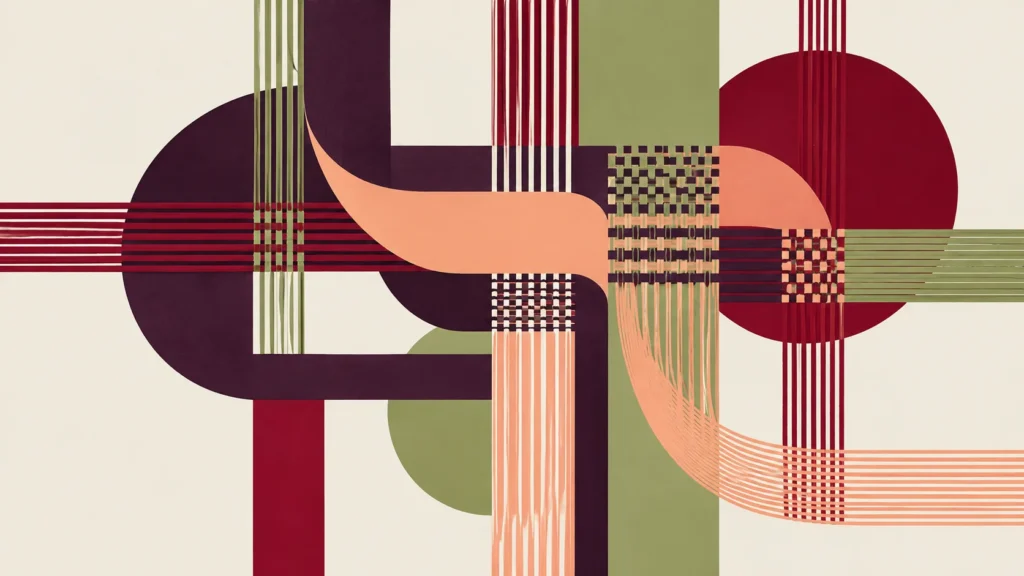
Our featured image, with its interlacing bands of burgundy, plum, peach and sage crossing in grids and curves, belongs to the visual world Albers helped to create. Its overlapping strips read both as painting and as cloth, which is exactly the ambiguity she explored. From the 1960s onward she turned increasingly to printmaking, carrying the same structural thinking into lithographs and screenprints.
Major retrospectives in Düsseldorf and at Tate Modern in 2018 and 2019 introduced her to a new generation, many of whom were surprised to find that the Bauhaus’s most radical artist might have been a weaver. It is a surprise Albers would have enjoyed. She spent her career showing that the line between art and craft was drawn by people, and could be redrawn by them too.


View comments (0)