

Walk through any large museum of antiquities and count the complete figures. There are not many. Heads without bodies, bodies without heads, a hand on a plinth, a sandalled foot, a torso that stops at the hips. Most of what survives from Greek and Roman sculpture is broken, and most of us have learned to love it that way.
That love is not as natural as it seems. The makers of these figures intended them to be whole, often painted in strong colours, sometimes with inlaid eyes of glass and stone. Renaissance collectors routinely had missing limbs restored. The cult of the fragment, the belief that a broken statue might be more expressive than a complete one, is largely a modern invention.
The torso that changed minds
Part of the story begins with the Belvedere Torso in the Vatican, a massive seated male figure signed by an Athenian sculptor named Apollonios. It has no head, no arms and no lower legs. Michelangelo is said to have refused to restore it, and he studied it closely; its twisting musculature echoes across the Sistine ceiling. In the eighteenth century Johann Joachim Winckelmann wrote a rapturous description of it, imagining the whole body from the part.
By the end of the nineteenth century, Auguste Rodin was making fragments on purpose. The Walking Man has no head and no arms, yet it seems more fully in motion than many of his complete figures. Rodin understood that what is missing can concentrate attention on what remains.
Rilke’s command
The poet Rainer Maria Rilke worked for a time as Rodin’s secretary in Paris and learned from him a way of looking. In 1908 he published “Archaic Torso of Apollo”, a sonnet about a headless statue in the Louvre. The poem describes a body that seems to glow from within, as if the missing head’s gaze had sunk into the chest. Then, without warning, it turns on the reader.
You must change your life.
Rainer Maria Rilke, “Archaic Torso of Apollo”, 1908
It is one of the most famous last lines in modern poetry, and it only works because the statue is incomplete. A whole Apollo would be a portrait of a god. A torso is a question, and the question, Rilke suggests, is addressed to us.
The sleeping head
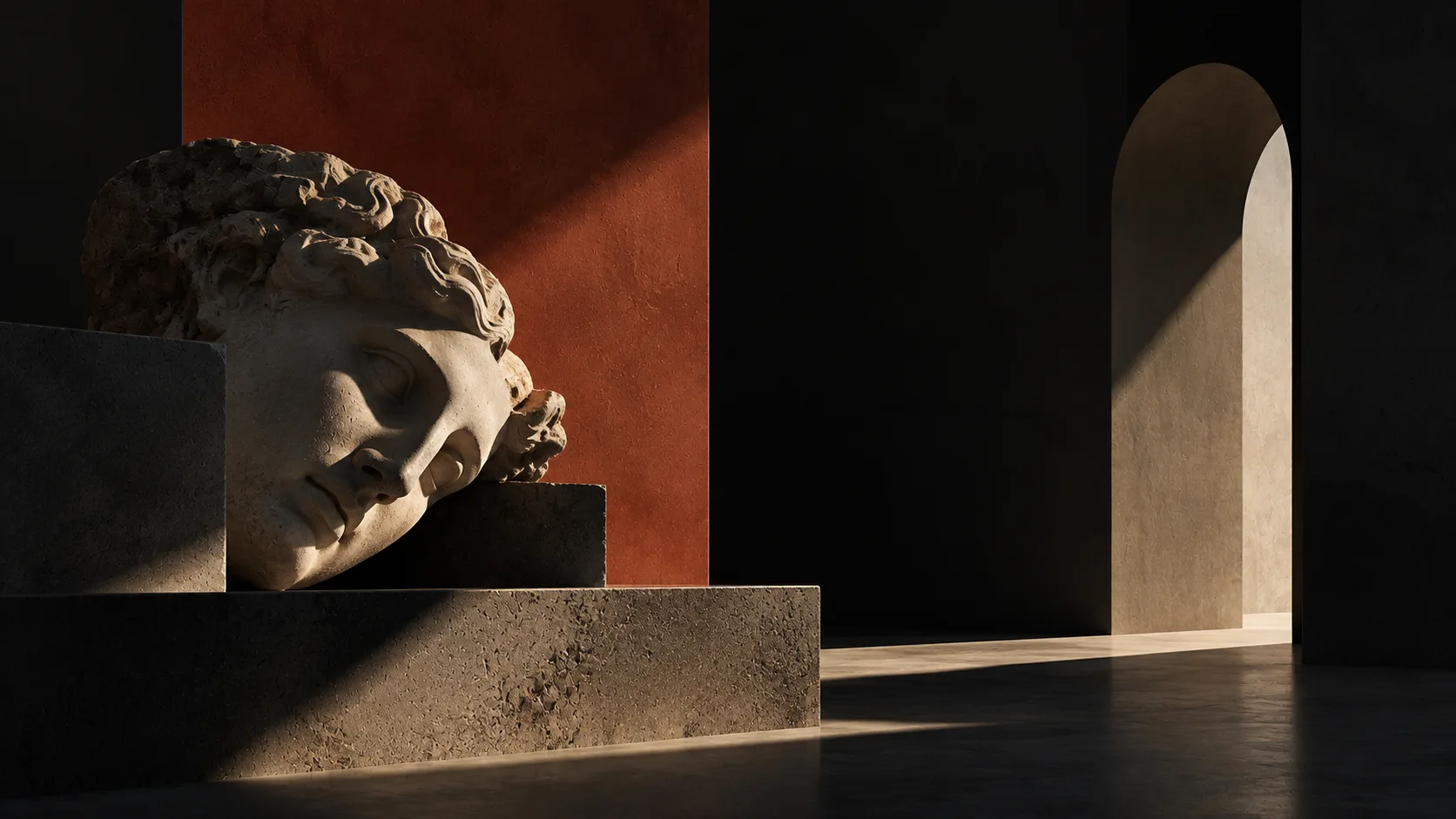
Our featured image shows a marble head lying on its side across a stone block, lit by a single raking beam in an otherwise dark room. It recalls Constantin Brâncuși’s Sleeping Muse of 1910, a smooth oval head laid horizontally as if dreaming, which reduced the classical portrait to almost nothing and found a new kind of calm there. Brâncuși laid his head down deliberately. Time and gravity did the same to countless ancient ones.
There is a quiet pleasure in a fragment placed like this, at rest rather than on display. Museums have learned to exploit it, lighting broken figures dramatically, giving them space, letting shadow complete the missing parts. Some critics find this manipulative, a way of turning archaeology into theatre, and they have a point. But the effect is also honest about something: we never see the ancient world whole, and pretending otherwise would be the larger illusion.
Living with incompleteness
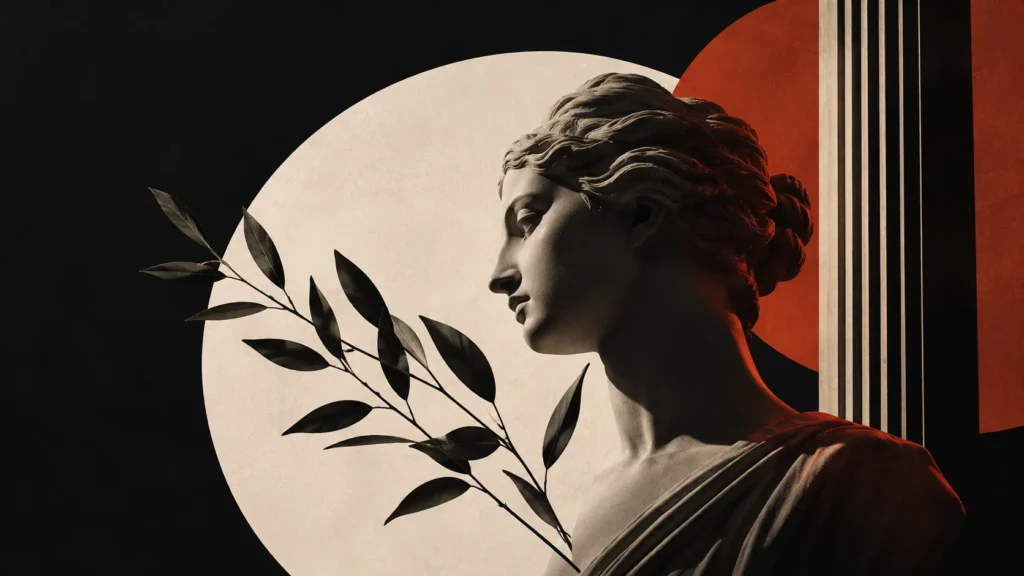
The appeal of the fragment reaches well beyond sculpture. Collagists work with torn pieces of found images, as in the classical profile recut above. Architects preserve ruined walls inside new buildings. Writers from Sappho, whose poems survive mostly in scraps of papyrus, to the modernists who learned from her, have treated gaps as a form of meaning. A missing word can be as eloquent as a present one.
Perhaps the fragment speaks to us because it resembles how we actually know things. Memory is broken. History is broken. Even our sense of another person is assembled from parts. The marble head on its plinth does not pretend otherwise, and there is something consoling in that refusal. It asks us to imagine the rest, and trusts that we can.





View comments (0)