
In the second half of the 1950s, the streets of Warsaw were covered with some of the most inventive graphic design of the century. Posters announced new films, Polish and foreign, without a single publicity still. A Western might be sold with a painted pistol and a blot of red, a comedy with a face made of a few hand-drawn lines. Many of the best were made by artists who had trained as painters and treated each commission as a picture in its own right.
A painter’s commission
The posters were commissioned by the state film distributor, which handed the work to individual artists rather than to advertising studios. Henryk Tomaszewski, who taught at the Academy of Fine Arts in Warsaw, set the tone: a poster, he argued, should give the passer-by an idea of the film, not a summary of it. His students and colleagues, among them Jan Lenica, Roman Cieślewicz, Wojciech Fangor and Waldemar Świerzy, took him at his word.
The result was a body of work that is unusually personal for commercial art. The same film could look completely different in Warsaw, Paris and Los Angeles, and the Polish version was often the strangest and the most memorable.
Faces and frames
The posters return again and again to the human face, often cut into strips, split by bands of colour or built out of other images. Cieślewicz in particular worked with collage and photographic fragments, enlarging the dots of a printed halftone until a face dissolved into pattern. Others painted heads that open like boxes, or let a profile emerge from a field of red.
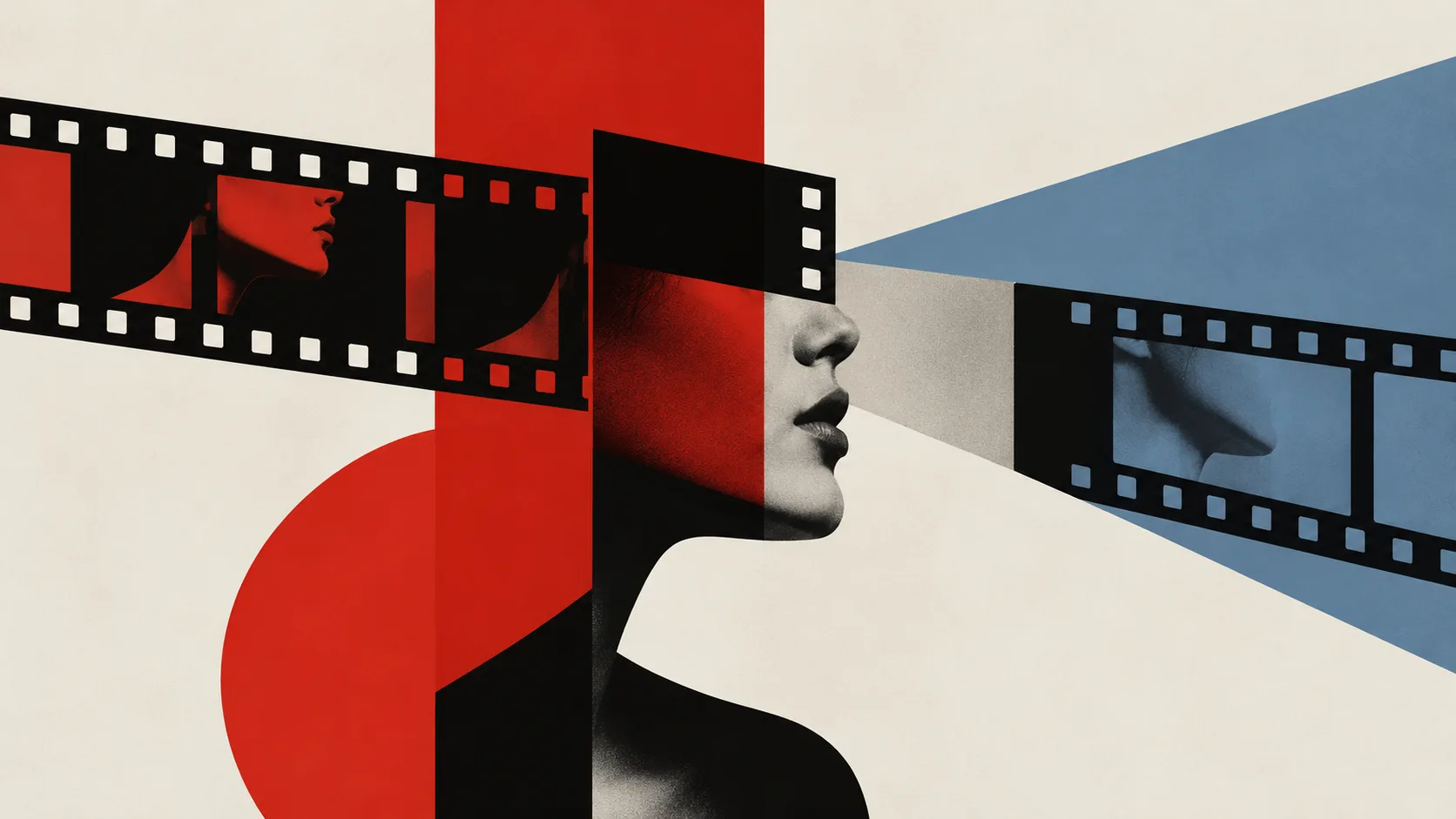
Our featured image borrows this language: a woman in profile, eyes hidden by a black bar, crossed by strips of film and a cone of blue projector light, with a red band and a red circle behind. It is a collage of the cinema as an apparatus that cuts the world into pieces and puts it back together.
Lettering by hand
Type mattered as much as image. Titles were usually drawn by hand, wobbling, dripping or stretched across the sheet, so that the words belonged to the picture instead of sitting on top of it. The names of actors and directors were treated as graphic elements in their own right, sometimes tucked so discreetly into a corner that the distributor complained.
Printing budgets were small, and many posters were made with a limited number of inks laid flat over the pale paper. The artists made a virtue of the restriction. A single strong colour, a large empty field and one surprising image became a style that designers have imitated ever since.
A school without a building
The Polish School of Posters was never an institution, only a name critics gave to a generation. Its reach was real all the same. Warsaw founded an International Poster Biennale in 1966, and in 1968 a Poster Museum opened in the old riding hall of Wilanów Palace, one of the first museums in the world given entirely to the form.
Today the posters are collected and reproduced endlessly, and their influence can be traced in record sleeves, magazine layouts and festival identities. Look at almost any film poster that offers one bold metaphor in place of a cast photograph, and the Warsaw painters are somewhere in the background, still drawing.



View comments (0)