
In 1931, in a studio in Hampstead, Barbara Hepworth cut a hole straight through a block of pink alabaster. The sculpture, later known simply as Pierced Form, was destroyed during the Second World War, and only photographs survive. But the gesture behind it shaped the next forty years of her work and a good part of British modern sculpture.
The idea sounds simple now. A sculpture is a solid object; making a hole in it lets air and light pass through and turns the inside into part of the outside. In practice it changed how a viewer moves around a work. You no longer look only at a pierced form. You look through it, and what you see on the other side becomes part of the piece.
Hampstead and the moderns
Hepworth was working in a remarkable neighbourhood. Henry Moore, her friend from art school in Leeds, lived nearby and was experimenting with holes at around the same time. Ben Nicholson, who became her second husband, was moving towards white reliefs of pure circles and rectangles. In the late 1930s Piet Mondrian and Naum Gabo both passed through the area as Europe darkened. The question of who made the first hole has been argued over ever since, and is not very interesting. What matters is what each artist did with it.
For Moore, the hole tended to be a cave or a hollow in a reclining body. For Hepworth it was something more abstract and more concerned with light: an eye, a window, a passage. Her forms are often upright and oval, with surfaces cut and polished so that the opening feels both carved and inevitable.
I rarely draw what I see. I draw what I feel in my body.
Barbara Hepworth
St Ives and the landscape
In 1939, with war approaching, Hepworth and Nicholson moved with their young triplets to Cornwall. She stayed there for the rest of her life. In 1949 she bought Trewyn Studio, a walled garden and workshop in the middle of St Ives, and it is still there, now a museum, with large bronzes standing among the palms and fuchsias.
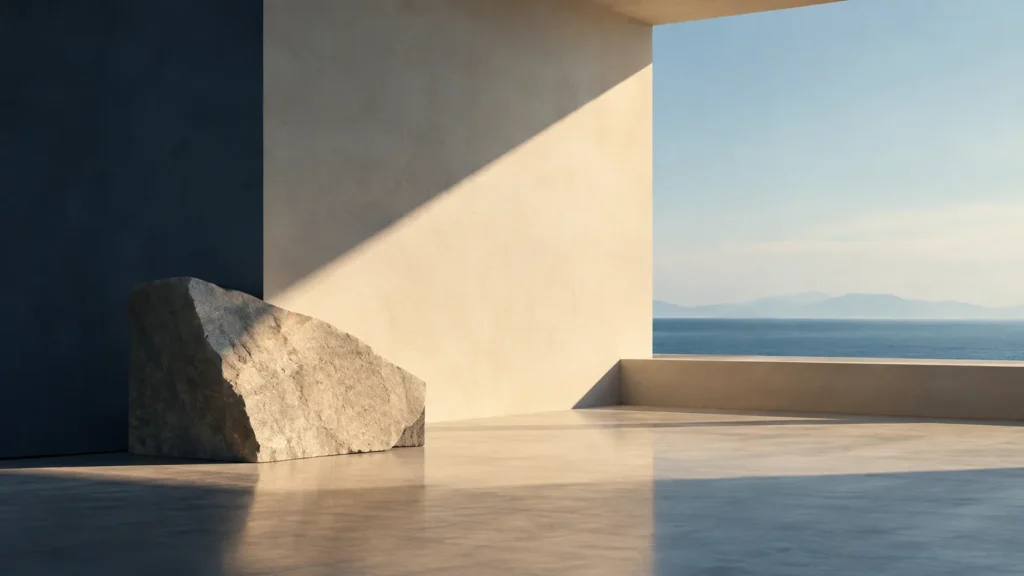
The Cornish landscape entered the work directly: standing stones, the rounded hollows of the cliffs, the line of the sea seen through a gap in the rock. Pelagos, carved in 1946, curls around itself like a wave or a bay, its hollow painted pale blue and strung with taut lines. In the image below, a rough boulder sits in a sunlit room that opens to the sea, close to the kind of meeting between stone and horizon she spent her life arranging.
Material and colour
Hepworth worked in stone, in wood and, increasingly after the 1950s, in bronze, which allowed larger pieces and outdoor commissions. She often painted the inside of her carved hollows white or blue, and threaded some works with strings, so that the hole became a space crossed by lines, like an instrument waiting to be played.
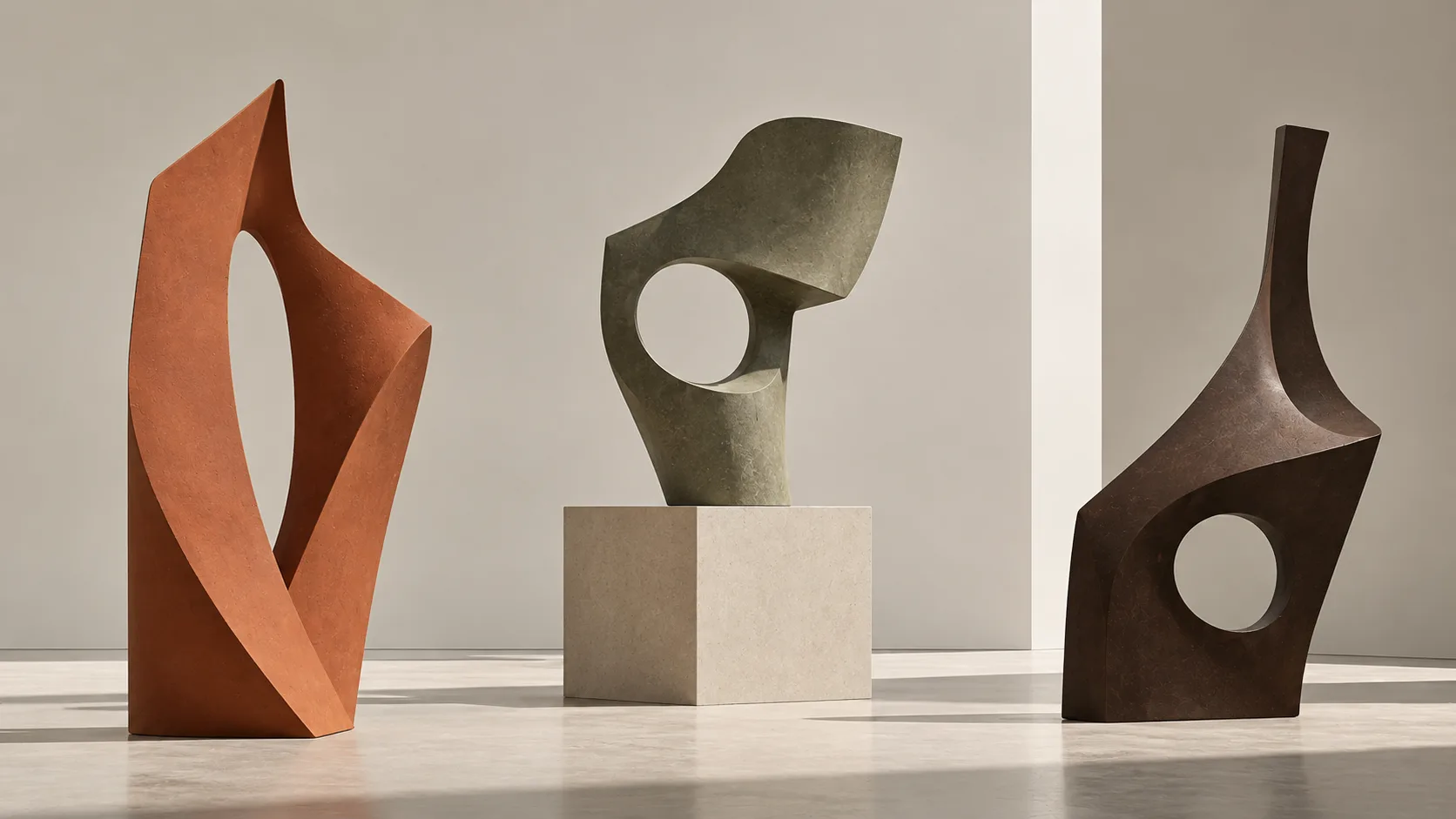
The three sculptures in our featured image echo this vocabulary: a tall terracotta form like a folded leaf, a sage green shape on a plinth with a single round opening, a dark bronze figure with its hole set high, like an eye. None of them is a Hepworth. They show how completely her language has passed into the general idea of what a modern sculpture looks like.
Single Form
Her best known public work is Single Form, a bronze more than six metres high unveiled at the United Nations headquarters in New York in 1964. It is a memorial to the Secretary-General Dag Hammarskjöld, who had owned her work and died in a plane crash in 1961. The sculpture is a tall, flat shape, gently curved, with a single small circular hole set near the top.
The hole is tiny compared with the mass around it, and it is enough. Look through it and the sky appears inside the bronze, a small disc of light held by a dark surface. That is the whole idea distilled: sculpture as a way of framing the world rather than blocking it out.
Hepworth died in a fire at Trewyn Studio in 1975. The garden is still full of her openings, and on a clear afternoon the light still comes through them, landing on the grass in small bright ovals that move as the day goes on.




View comments (0)