

Peter Brook’s The Empty Space was published in 1968, when its author was already one of the most celebrated directors in Britain. It opens with a sentence that has been quoted in almost every theatre school since.
I can take any empty space and call it a bare stage.
Peter Brook, The Empty Space, 1968
Brook goes on to say that a person walking across that space while someone else watches is all that is needed for an act of theatre. Everything else, the curtains, the lighting rig, the scenery, the building itself, is optional. Useful, sometimes beautiful, but optional.
Four kinds of theatre
The book divides theatre into four types. The Deadly Theatre is the routine, respectable kind that goes through the motions. The Holy Theatre tries to make the invisible visible through ritual and intensity. The Rough Theatre is popular, noisy and improvised, close to the music hall and the fairground. The Immediate Theatre is Brook’s ideal, a theatre that discovers itself afresh in each performance.
Brook spent the rest of his long career pursuing that last idea. In 1974 he took over the Bouffes du Nord, a half-derelict nineteenth-century theatre near the Gare du Nord in Paris, and kept its scarred walls as they were. Productions there and on tour, from The Mahabharata to a pared-back Hamlet, often used little more than a carpet, a few objects and very good actors.
A country road, a tree
Brook’s book appeared fifteen years after the first production of Samuel Beckett’s Waiting for Godot, at the small Théâtre de Babylone in Paris in January 1953. Beckett’s direction for the setting is famously brief: a country road, a tree, evening. Two men wait. The critic Vivian Mercier summed it up as a play in which nothing happens, twice.
Beckett’s later plays reduced the stage even further: a woman buried to her waist in a mound of earth, a mouth lit in total darkness, an old man alone with a tape recorder. Each is an experiment in how little theatre needs before it stops being theatre. The answer, again and again, turns out to be less than you think.
The chair
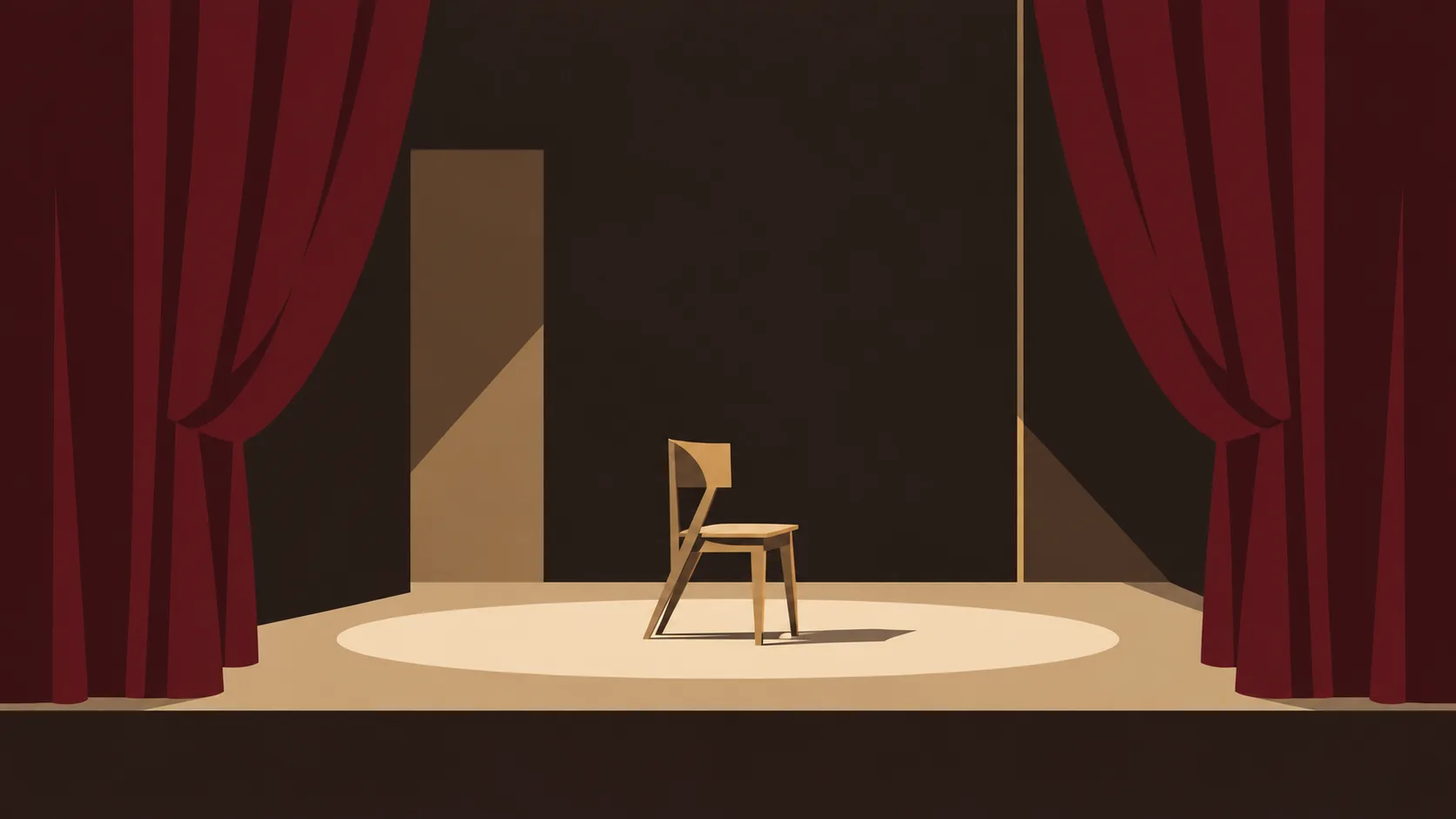
Our featured image shows a wooden chair alone on a stage between heavy red curtains, in a circle of warm light. Nothing else. It might be the moment before a play begins or after it has ended. It might be the set for a play in which the chair is all there is.
Chairs have a particular power on stage because they imply a body. Eugène Ionesco’s The Chairs, first staged in 1952, fills the stage with empty seats for invisible guests until the absence becomes overwhelming. In countless rehearsal rooms a single chair stands in for a throne, a car, a grave. Theatre has always relied on the audience’s willingness to see one thing as another.
There is also the ghost light, the single bulb left burning on an empty stage overnight in many theatres. The practical explanation is safety; the superstitious ones involve the spirits of old productions. Either way the image is the same: a lit space waiting for someone to walk into it.
Why emptiness still matters
It would be easy to read all this as a simple aesthetic of minimalism and set it against big, expensive productions with moving sets and video walls. That would miss the point. Brook was not against spectacle; some of his productions were spectacular. He was against habit, the kind of theatre that relies on its machinery instead of its imagination.
Many of the most interesting companies working today have taken his challenge literally, performing in warehouses, flats, churches and car parks, or touring with nothing but a van of props. Their productions often cost little and demand a lot, from performers and audiences alike. The bare floor becomes a contract: the audience agrees to imagine, and the actors agree to give them something worth imagining.
The empty space is a test. Take away everything that can be taken away, and see what is left. If something still passes between the person walking across the floor and the person watching, you have theatre. If nothing does, no amount of scenery will save it.





View comments (0)