

Vilhelm Hammershøi painted the same apartment for more than a decade. From 1898 to 1909 he and his wife Ida lived at Strandgade 30 in Copenhagen, in an old merchant’s house near the harbour, and he made dozens of paintings of its rooms. Doors open onto other doors. Windows cast pale rectangles on bare floorboards. Sometimes Ida stands with her back to us, reading or sewing. Often there is no one there at all.
The palette is narrow: greys, off-whites, a muted brown, a black dress. The light comes from the side, low and northern. Nothing happens. And yet these pictures have an intensity that more dramatic paintings of the period often lack.
The beauty of an empty room
Hammershøi gave very few interviews and left almost no writing. One remark, recorded in 1907, is quoted again and again because it seems to explain everything.
I have always thought there is such beauty about a room like this, even though there are no people in it, perhaps precisely when there are none.
Vilhelm Hammershøi, interview, 1907
The phrase “perhaps precisely” is the key. Hammershøi’s rooms are not merely empty; they have been emptied. The furniture is reduced to a chair, a table, a piano. The pictures on the walls become grey rectangles. In Dust Motes Dancing in the Sunbeams, painted in 1900, the only movement in the room is the light itself, falling through a window onto the floor.
Painting like a photograph
It is often said that Hammershøi’s paintings look like photographs, and the comparison is useful as long as it is not taken too literally. What they share with photography is a sense of the frame as an accident, a slice cut out of continuous space. Doorways are cropped. The edge of a table enters from nowhere. The viewpoint is the height of a standing person who has just walked in and stopped.
Photographers have kept returning to his territory. Francesca Woodman made her best-known pictures in the 1970s in decaying empty rooms in Providence and Rome, letting her own blurred body appear and vanish against peeling walls. Contemporary interior photography, for better or worse, has absorbed his quiet geometry wholesale.
The torn print
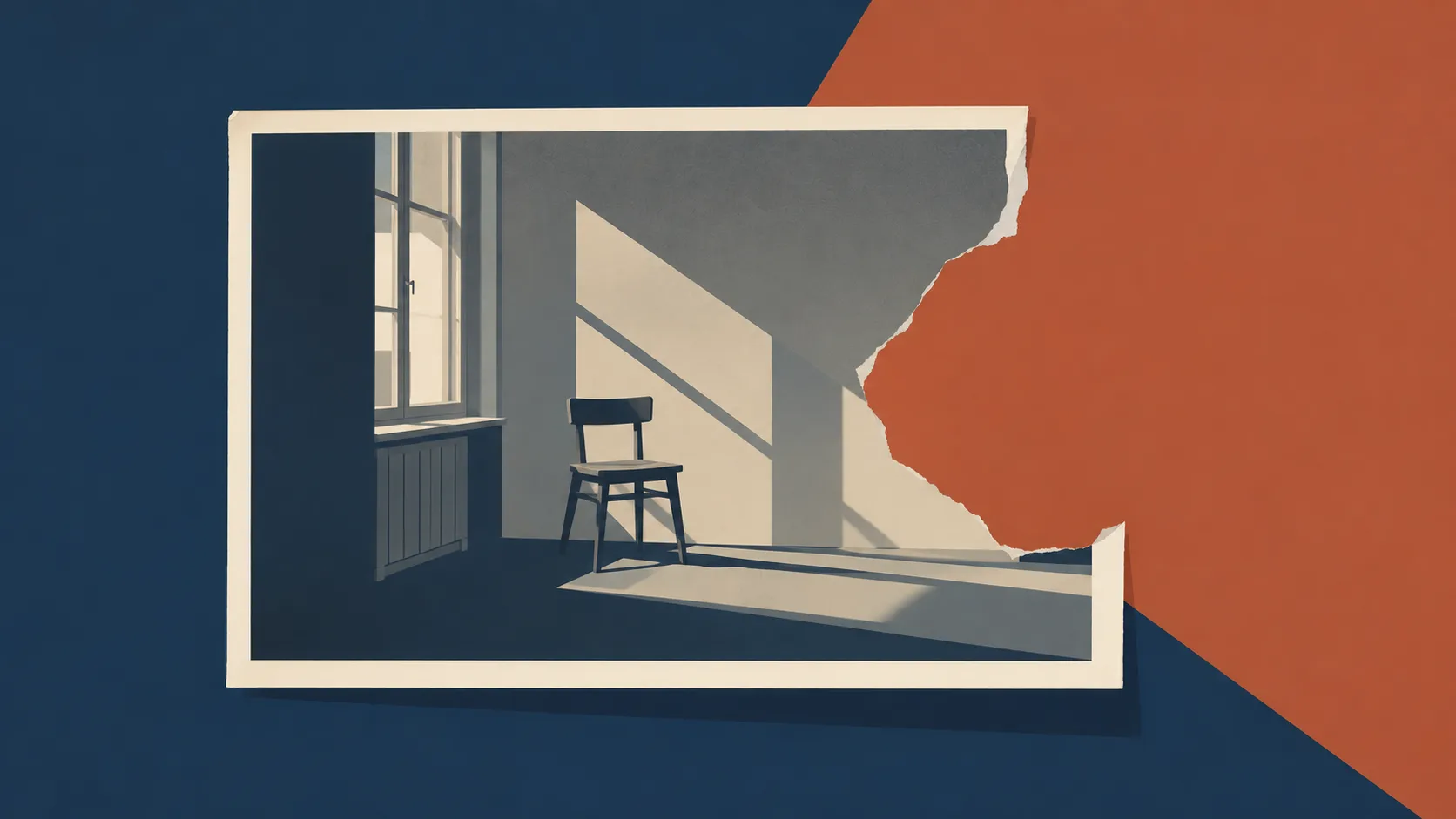
Our featured image places a black-and-white photograph of an empty room, a single wooden chair in a shaft of window light, against a background of deep blue and rust. The right side of the print has been torn away. It is an image about absence twice over: a room with no one in it, and a photograph with a piece missing.
That doubling would have made sense to Hammershøi, whose work is so often about what cannot be seen: the face of the woman turned away, the room behind the closed door, the person who has just left. His paintings fell out of fashion soon after his death in 1916, overshadowed by the more colourful modernisms that followed. They were rediscovered late in the twentieth century, and major exhibitions in Paris, New York and London have since made him one of the most admired Scandinavian painters.
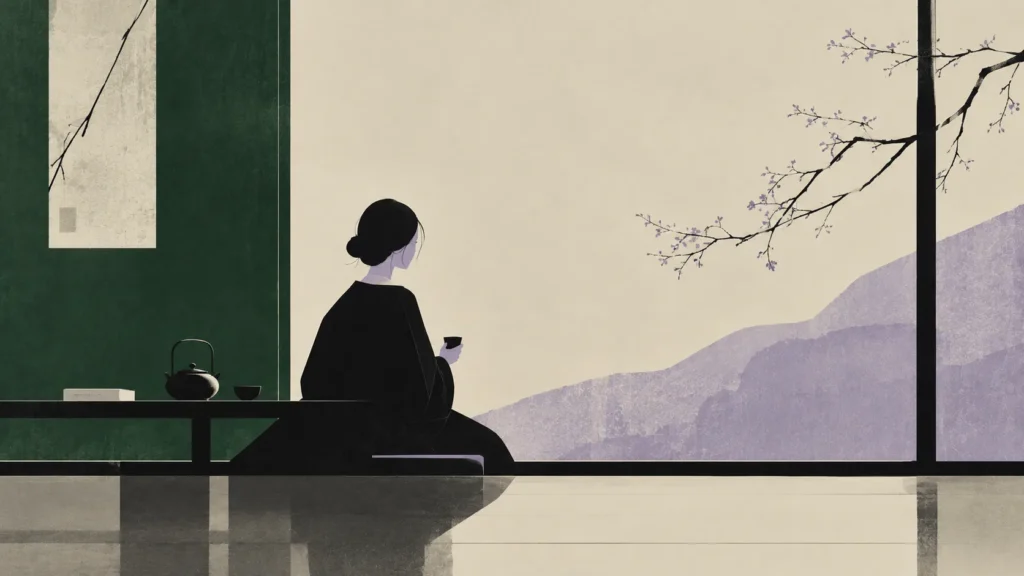
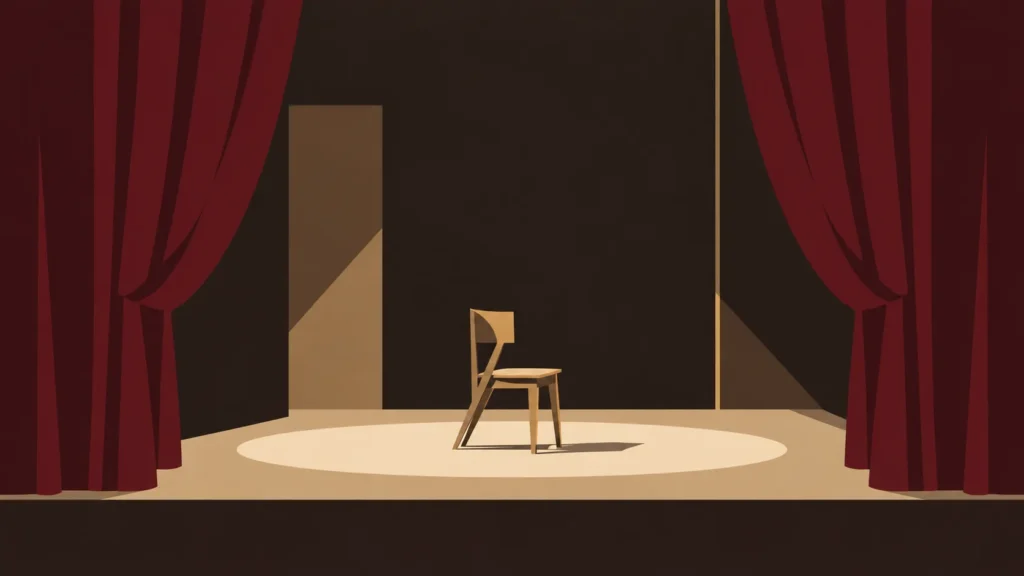
The two images above extend his vocabulary: a woman seated by a window, seen from behind, with a teapot on a low table; a single chair on a bare stage, waiting under a spotlight. Both are scenes in which something is about to happen, or has just finished. Hammershøi’s gift was to make that pause the whole subject.
Learning to look at nothing
There is an exercise worth trying in any room you know well. Wait until it is empty, in the late afternoon. Stand in the doorway and do not go in. Look at the light on the floor, the angle of a chair, the way one wall is brighter than the other. After a minute the room starts to feel less like a container and more like a presence.
That is the feeling Hammershøi spent his life painting, and it is still available to anyone willing to stand still for long enough to notice it.



View comments (0)