

In 1933 the novelist Jun’ichirō Tanizaki published a long, digressive and occasionally cantankerous essay about light. In’ei raisan, translated into English in 1977 as In Praise of Shadows, begins with the problem of how to fit electric wiring, heaters and a modern bathroom into a traditional Japanese house without ruining it. It ends as one of the most influential texts on aesthetics of the twentieth century.
It is a book architects still press into the hands of students and designers still quote on mood boards. It deserves a more careful reading than it usually gets.
Lacquer by candlelight
Tanizaki’s central claim is that traditional Japanese objects and rooms were made to be seen in dim light, and that bright electric illumination destroys them. Lacquerware, he argues, looks garish in daylight. But place a lacquer bowl in a dark room lit by a single candle, and its black and gold surfaces come alive, the gold catching the flame in a way that seems to gather all the remaining light in the room.
He makes similar arguments about paper screens, which filter rather than block the sun, about the tokonoma alcove, whose shadow he considered its real content, and even about the old-fashioned toilet, a detached room among moss and leaves where one could listen to the rain. Much of the essay is funny, and Tanizaki knows it.
We find beauty not in the thing itself but in the patterns of shadows, the light and the darkness, that one thing against another creates.
Jun’ichirō Tanizaki, In Praise of Shadows, translated by Thomas J. Harper and Edward G. Seidensticker
Gold in darkness
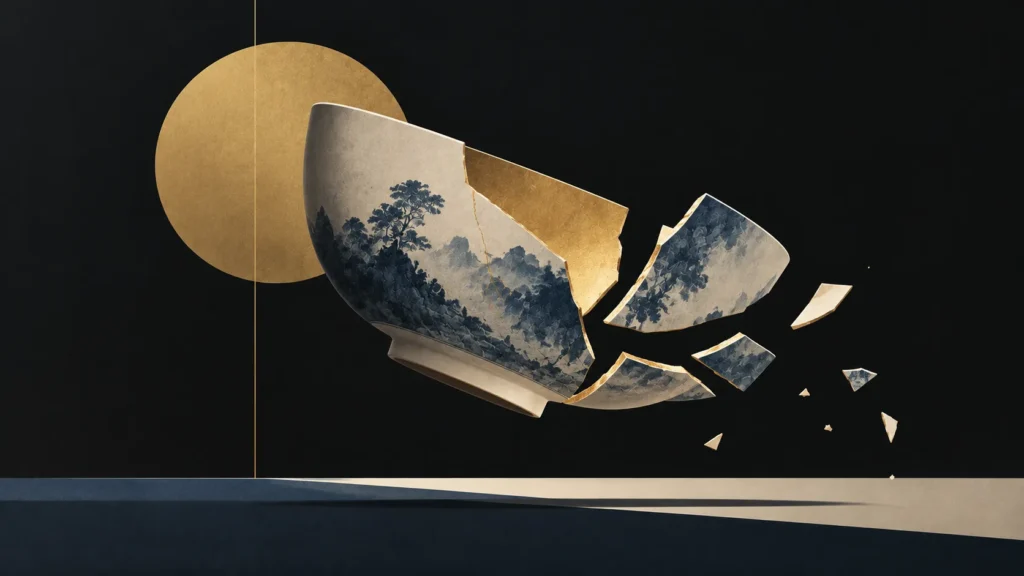
One of the most beautiful passages concerns gold leaf, used on folding screens and on the inside of lacquer boxes. In a bright room, he suggests, gold can look vulgar. Deep in an old house, far from any window, it holds the faint light that reaches it and glows softly, a kind of lamp without a flame. The image above, a blue-and-white bowl bursting apart in front of a gold disc on a black ground, shows that relation between gold and darkness in a more violent key.
Reading it carefully
It is important not to read In Praise of Shadows as a simple celebration of timeless Japanese taste. Tanizaki was writing in a decade of rising nationalism, and the essay contains generalisations about East and West, and about skin colour, that are uncomfortable to read now. It is also deeply ironic. Tanizaki lived in modern houses, enjoyed Western comforts and wrote novels about the collision of old and new. The essay is as much a lament for something already gone as a programme for preserving it.
Its most lasting idea is not about Japan at all. It is the suggestion that every technology of light carries an aesthetic with it, and that when we change the light we change what is beautiful. A room lit evenly from the ceiling flatters a different set of objects from a room lit by a low lamp and a window. Design that ignores this produces things that look wrong in the places where people actually live.
The tea room today
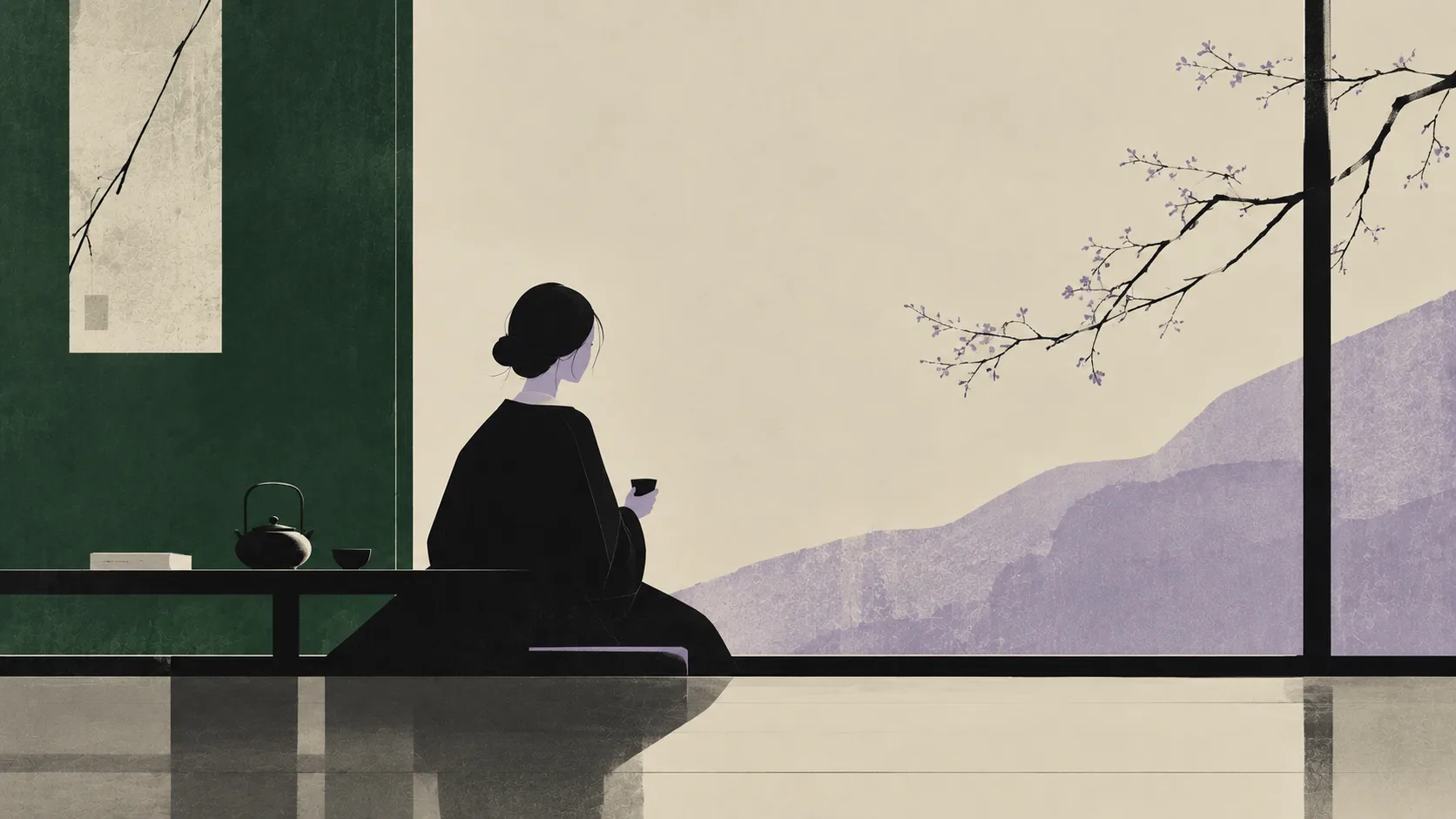
The woman in our featured image sits in a quiet room, cup in hand, a teapot on a low table and a hanging scroll on the green wall, while a branch in blossom and a ridge of lilac mountains fill the window. The light is soft and even, but shadows still pool under the table and gather in the reflections on the floor.
It is a calm scene, and a reminder that Tanizaki’s real subject was attention. Shadows slow us down. They hide part of a thing and make us look harder at the rest. In an age of bright screens and evenly lit interiors, that is still a useful provocation.
Turn off one light in a room tonight, and see what appears.




View comments (0)