
Fashion history is often told through hemlines, but the shoulder may be the better guide. Where a garment places the shoulder, how wide it makes it, whether it lets it slope or squares it off, says a great deal about what a period thought a body should be and do. Our featured image sets three garments side by side, and together they trace roughly a century of answers.
The armoured bodice
On the left, a dark wine bodice of the 1890s: high collar, a long row of small buttons, a sharply cinched waist and sleeves that swell at the top before tightening along the forearm. These were known as leg-of-mutton sleeves, and at their peak in the middle of the decade they grew so large that they needed padding or stiffened linings to hold their shape.
The silhouette was built, not simply worn. Corset, boned bodice and inflated sleeve together turned the upper body into a sculpture that made the waist look impossibly small by contrast. It was a style of display and restriction at once, and the restriction was part of the message.
The released body
In the centre, a dark green dress with a dropped waist, straight lines and a pleated skirt, of the kind that defined the 1920s. The shoulders are narrow and natural; the garment hangs from them rather than gripping the torso. Designers such as Coco Chanel and Jean Patou built reputations on clothes like this, borrowed in part from sportswear and menswear.
Even more radical in its way was the work of Madeleine Vionnet, who cut fabric on the bias so that it clung and moved with the body without internal structure. Vionnet draped her designs on a small wooden mannequin before scaling them up, treating the dress as a three-dimensional problem rather than a flat pattern. The result was clothing that seemed to have no construction at all, which of course required enormous skill.
Fashion is architecture: it is a matter of proportions.
Attributed to Coco Chanel
The questioning jacket
On the right, a dusty pink jacket that seems to be coming apart: one lapel folds over the other, the hem drops in a long asymmetric drape, the button sits where you would not expect it. This belongs to the deconstruction that arrived in Paris in the early 1980s, when Rei Kawakubo of Comme des Garçons and Yohji Yamamoto showed collections in black, torn, wrapped and unevenly cut. Some French critics responded with open hostility.
By the end of the decade Martin Margiela was turning garments inside out, exposing linings, seams and tacking stitches. The shoulder, which had been inflated to huge widths by the power dressing of the same years, became something to question rather than exaggerate. Kawakubo’s collection for spring 1997, Body Meets Dress, Dress Meets Body, padded dresses in unexpected places, giving the body new swellings rather than an idealised line.
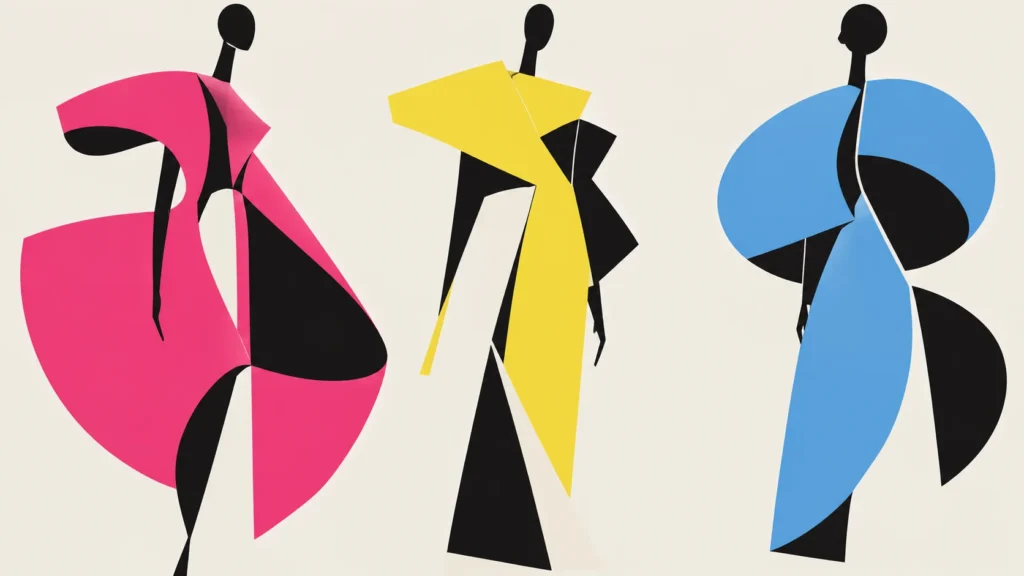
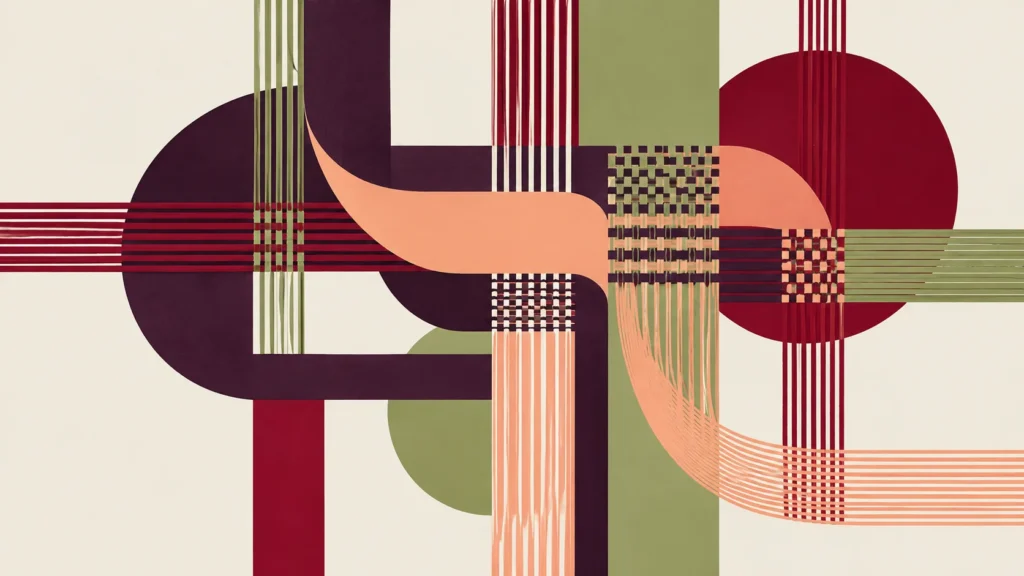
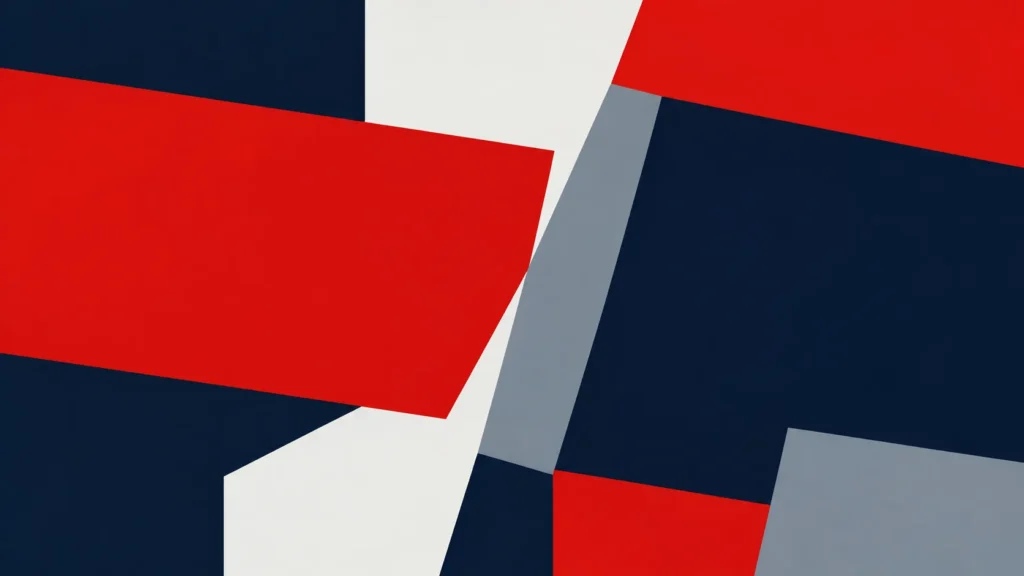
The other images in this set extend the conversation. Three abstract figures wear garments of pure colour, cut from flat geometric planes, like a sketch for clothes that would be built rather than sewn. A woven composition of bands and grids recalls how much of fashion begins as textile. A hard-edged painting of red and navy planes brings to mind Yves Saint Laurent’s dresses of 1965 based on the paintings of Piet Mondrian, perhaps the most famous moment when a garment became a canvas.

What the shoulder tells us
Put the three garments in a row and a pattern appears. The first imposes a shape on the body. The second lets the body determine the shape. The third asks whether there is a correct shape at all. None of these answers has replaced the others; a contemporary wardrobe contains all three, sometimes in the same outfit.
That is the real interest of fashion history. It is not a neat sequence of styles but an argument that keeps reopening, and that is conducted in cloth rather than words. Every time a designer moves the seam on a shoulder by a few centimetres, they rejoin it, whether they know the history or not.







View comments (0)