
In the classical gardens of Suzhou, a visitor is rarely allowed to see everything at once. The paths turn, walls interrupt, and the views arrive in carefully measured portions, framed by doorways shaped like vases, leaves, gourds and, most famously, the full circle of the moon gate. Step through one of these round openings and the garden on the other side appears as a finished picture, already composed.
The craft of gardens
The most important text on the subject is Yuan Ye, usually translated as The Craft of Gardens, written by the garden designer Ji Cheng and published in the 1630s. It is a practical manual, full of advice on siting pavilions, choosing rocks and designing lattice windows. Its final chapter is devoted to a single idea: jiejing, or borrowed scenery.
Borrowing views is the most important element in garden design.
Ji Cheng, Yuan Ye, c. 1631 (English rendering)
To borrow a view means to bring something outside the garden into its composition: a distant pagoda, a mountain ridge, the tops of a neighbour’s trees, even the sound of a temple bell. The garden’s walls are not there to exclude the world but to edit it, so that what lies beyond becomes part of what is within.
Shakkei in Kyoto
The idea travelled to Japan, where it is known as shakkei. Some of its best known examples are in and around Kyoto. At Entsū-ji, a small temple in the north of the city, a flat moss garden studded with low stones is closed by a clipped hedge, and above the hedge, framed between the trunks of trees, rises Mount Hiei. The whole garden exists to set up that view.
The technique depends on control of the middle ground. Something must hide the clutter between the garden and its borrowed scene, so that the distant mountain seems to sit directly on the near hedge. Today that is increasingly difficult as new buildings rise in the gap, and Kyoto has introduced planning rules to protect several of its famous borrowed views.
Stone, frame, water
Our featured image distils the vocabulary: a rough boulder on a pale stone floor, a slender tree growing improbably out of it in autumn leaf, and beyond, a round opening in a smooth wall that frames a lake and the folding lines of mountains. The images collected here repeat the gesture in different keys.
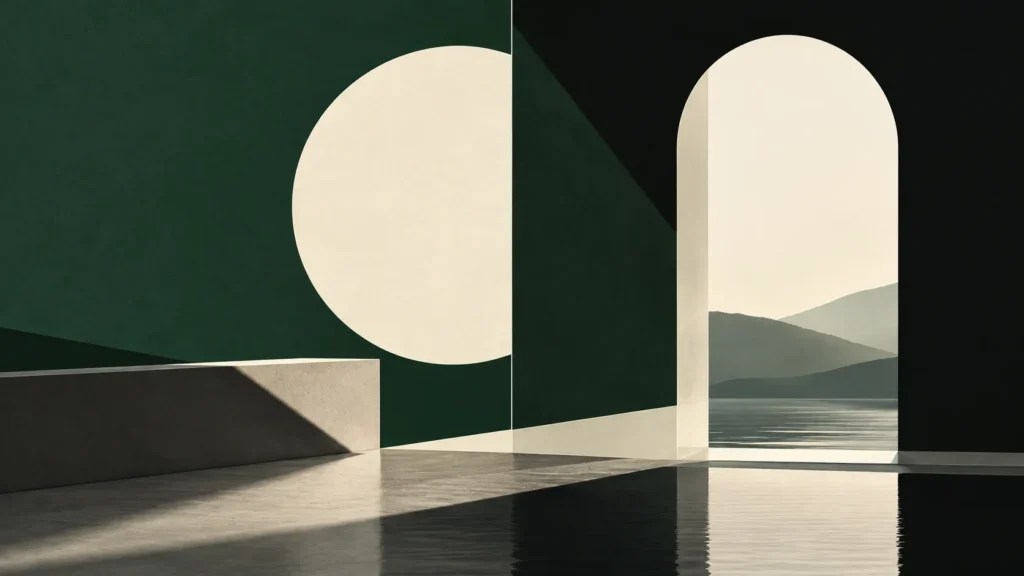
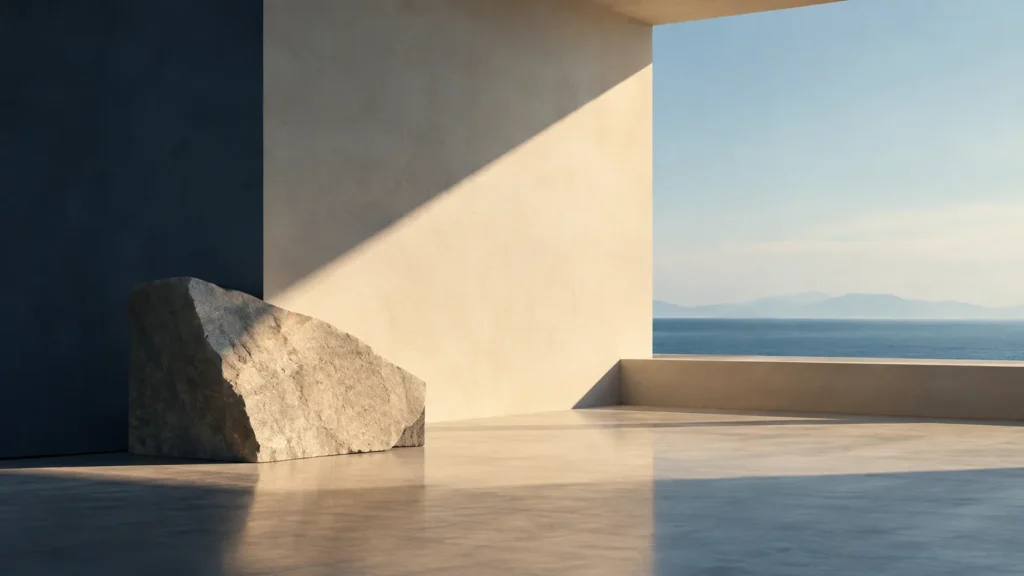
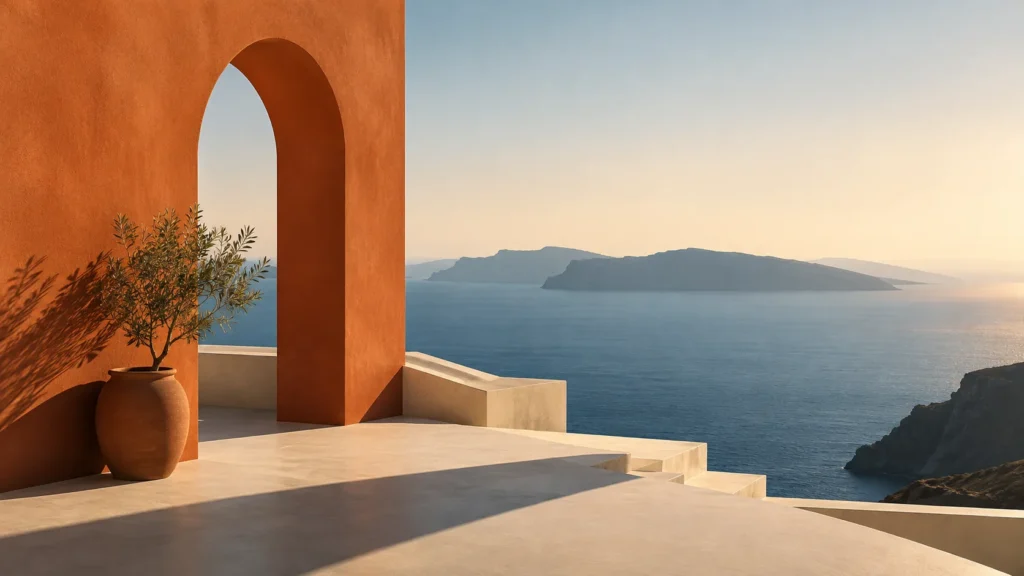
An arched doorway in a dark green wall opens onto still water. A boulder rests in a sunlit room with one side open to the sea. A terracotta arch on a terrace frames islands in the evening haze. A woman sits with tea in a room whose window is filled by a flowering branch and a lilac ridge. In every case the architecture does less than it could, so that the landscape can do more.
Rocks as mountains
The boulder in these images has deep roots too. Chinese scholars collected strangely shaped stones, especially the porous, eroded limestone taken from Lake Tai near Suzhou, and set them in gardens and on desks as miniature mountains. A single rock could stand for a whole range. Contemplating it was a way of travelling without leaving home.
This shift of scale is at the heart of the borrowed view. A garden of a few hundred square metres claims a mountain many kilometres away; a stone the size of a sheep stands for a peak. The mind does the work of connecting them, and the designer’s job is to make that connection feel inevitable.
It is a lesson modern architecture has learned only in part. Picture windows and glass walls give us views, but often too much of them, all at once, with no threshold. The moon gate offers something rarer. It makes you stop, choose a single point of view and look properly. In a world of endless panoramas, a circle cut into a wall can still come as a surprise.




View comments (0)