
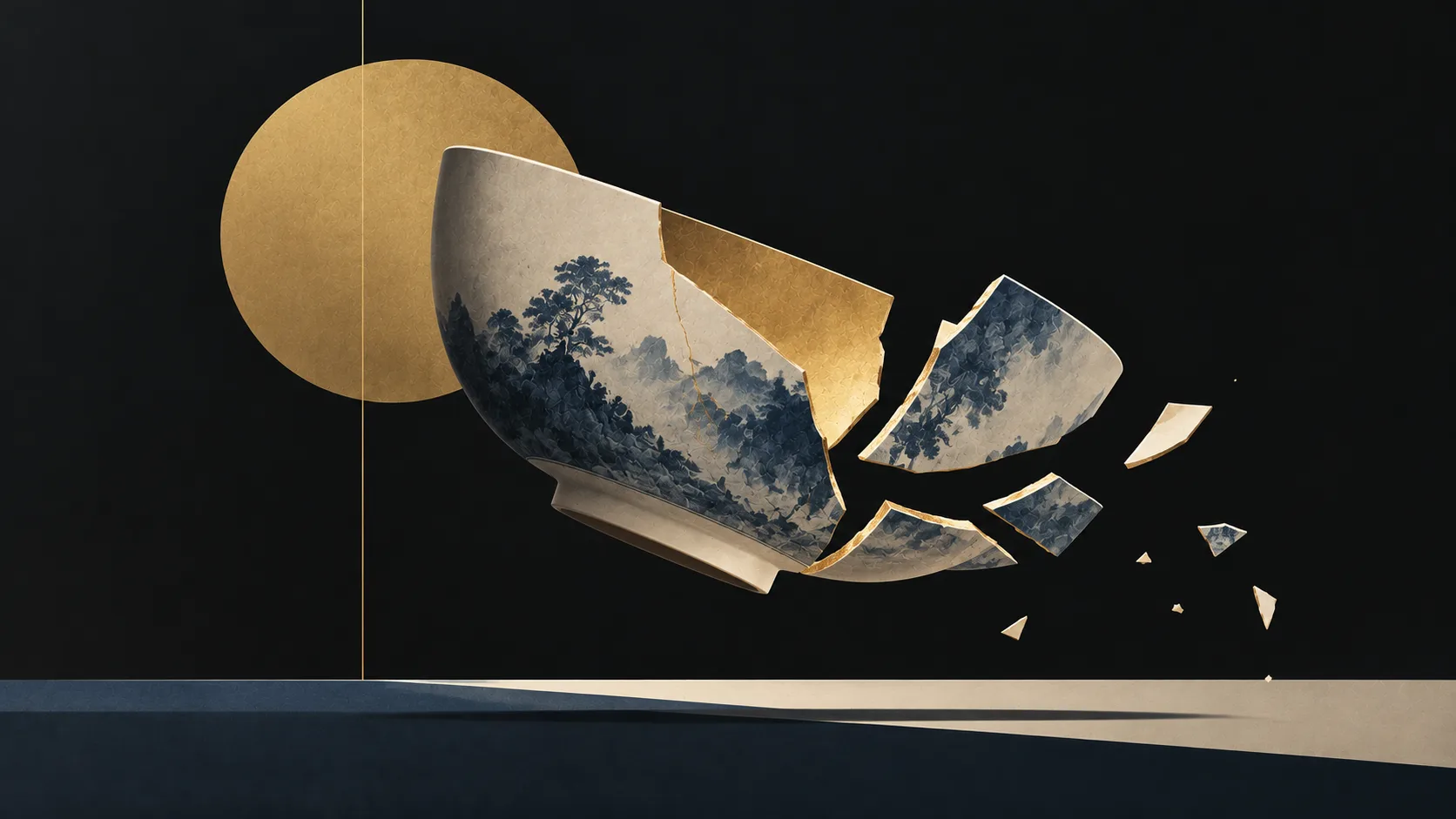
The story is usually told like this. In the fifteenth century the shogun Ashikaga Yoshimasa broke a favourite Chinese tea bowl and sent it back to China to be mended. It returned held together with crude metal staples. Unimpressed, he asked Japanese craftsmen to find a better way, and they developed kintsugi: joining the pieces with urushi lacquer and dusting the seams with powdered gold.
Like most origin stories, it is too neat to be trusted entirely. Lacquer repair was practised in Japan long before Yoshimasa, and the stapled bowl of the legend, a celadon known as Bakōhan, survives in the Tokyo National Museum still wearing its metal clamps. What the legend gets right is the attitude. Somewhere in the culture of tea, a damaged object stopped being something to hide.
The tea room as a school of attention
Tea masters of the sixteenth century, above all Sen no Rikyū, pushed taste away from the polished Chinese wares favoured by earlier collectors and toward rough, local, irregular pieces. A bowl was valued for its history of use, its uneven glaze, the way its weight sat in two hands. In that setting a repair line was not a flaw added to a perfect object. It was another event in the bowl’s biography, recorded in the most precious material available.
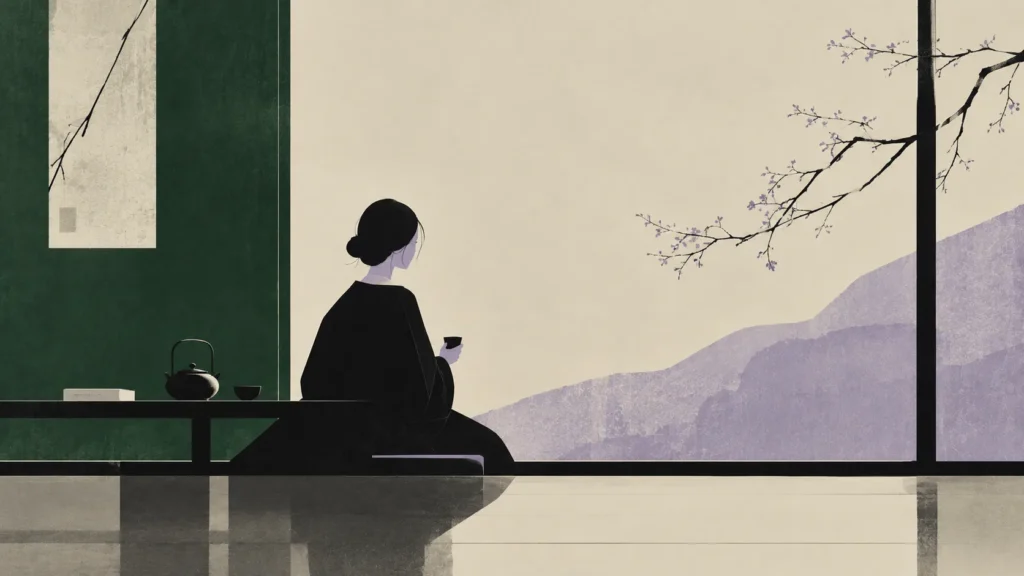
It helps to remember how slow the process is. True urushi is the sap of a tree related to poison ivy; it irritates the skin, cures only in warm and humid conditions, and must be applied in thin layers over weeks. A properly mended bowl can take a month or more. The gold is the last and smallest part of the work. The structure is the lacquer.
A metaphor that travels too easily
In the last twenty years kintsugi has become a favourite image of self-help books, therapy blogs and corporate resilience workshops. The broken bowl stands for the wounded person, the gold for whatever wisdom the wound is supposed to have produced. There is something to this, but the metaphor tends to skip the inconvenient parts: the weeks of waiting, the toxicity of the material, the fact that most things that break are simply thrown away.
The kits sold online, which use epoxy resin and metallic powder, make the gap plain. They reproduce the look of the gold seam in an afternoon. What they cannot reproduce is the decision, made over a long time, that this particular object is worth the trouble.
Have nothing in your houses that you do not know to be useful, or believe to be beautiful.
William Morris, “The Beauty of Life”, 1880
Morris was writing in a very different tradition, against the clutter of the Victorian parlour, but his rule sits comfortably beside the ethic of the tea room. Both ask for fewer things, chosen more carefully and kept for longer. Repair follows naturally from that. You only mend what you have decided to keep.
Repair as a design brief
A growing body of contemporary work treats repair as a design problem rather than a mood. Ceramicists in Japan and Europe teach traditional urushi methods to new students; furniture makers design joints that can be opened and renewed; clothing labels offer free mending for the life of a garment. The common thread is visibility. A visible repair tells the next owner that the object has been looked after, and invites them to continue the work.
There is also a quieter argument about value. An object that has been repaired carries a record of care that no new object can have. In a culture built on replacement, that record is a small act of resistance, and a reminder that the price of a thing is not the same as its worth.
The moment after the noise
The bowl in our image, painted in cobalt with a misty landscape of trees, is caught at the moment of breaking, its pieces suspended in the air in front of a gold disc. It is a reminder that every mended object was once in exactly this state, and that someone chose, after the noise, to kneel down and pick the fragments up.
That choice is the real subject of kintsugi. The gold only makes it legible.







View comments (0)